
Conclusions
- The editorial page of The Wall Street Journal on Friday July 24, 2026 notes a sharp increase in arbitrated health insurance payments for member’s out-of-network care. This Navigator corroborates those trends as reflected in associated administrative costs.
- Independent Dispute Resolution (IDR) Fees rose sharply among Blue Cross Blue Shield Plans as No Surprises Act arbitration expanded. The Comprehensive median expense rose from $0.01 per member per month in 2023 to $0.22 in 2025; for Total Commercial Insured the median rose from $0.01 to $0.31.
- Among continuously participating Plans, IDR Fees grew at medians of 43.7% in 2024 and 41.8% in 2025 on a Comprehensive basis — far exceeding total administrative expense growth (6.6% and 0.5%) and Corporate Services cluster growth (1.8% and 3.7%).
- Between 2023 and 2025, the $0.21 increase in the Comprehensive fee equaled 4.4% of the $4.91 increase in total comprehensive administrative expense and 28.6% of the $0.75 increase in the Corporate Services cluster.
Background
The editorial states that a surge in health expenses has stemmed from the No Surprises Act of 2020, passed in connection with Covid legislation in December of that year. The intent of the legislation was to eliminate the risk to consumers for health expenses of “emergency care at hospitals outside their insurance network, or at in-network hospitals that contract with out-of-network providers.”
The editorial, “The ‘Surprise Billing’ Racket”, states the Act created an arbitration system in which arbitrators select between the providers’ rates and the in-network rates of the insurer. The effect of the legislation “ended surprise bills but swelled costs for insurers, which are now being passed along in higher premiums.” The editorial cites vastly higher than expected disputes going to arbitration, 2.6 million in 2025 versus 17,000 projected. Elevance reports claims expenses surging by “30% between last year’s fourth quarter and this year’s first.”
Analysis
Significant increases in arbitration expenses borne by health plans are a reflection of the increase in health benefit expenses. In the Sherlock Benchmarks, these fees, Independent Dispute Resolution Fees, are segmented as a category of Legal, within the Corporate Services Function, shown in the Appendix. This subcategory captures those expenses arising from the Federal Independent Dispute Resolution process established by the No Surprises Act, as well as similar expenses incurred in state IDR processes. Any fees refunded to the plan as the prevailing party is included as a net expense.
Based on the anecdotes cited by the WSJ, arbitration expenses themselves are a small fraction of the effect on health benefits. Also, the expense we capture does not include any internal expenses such as the cost to manage IDR disputes. According to federal agency estimates, cited by Hoadley and Watts, these costs are $857 per dispute.
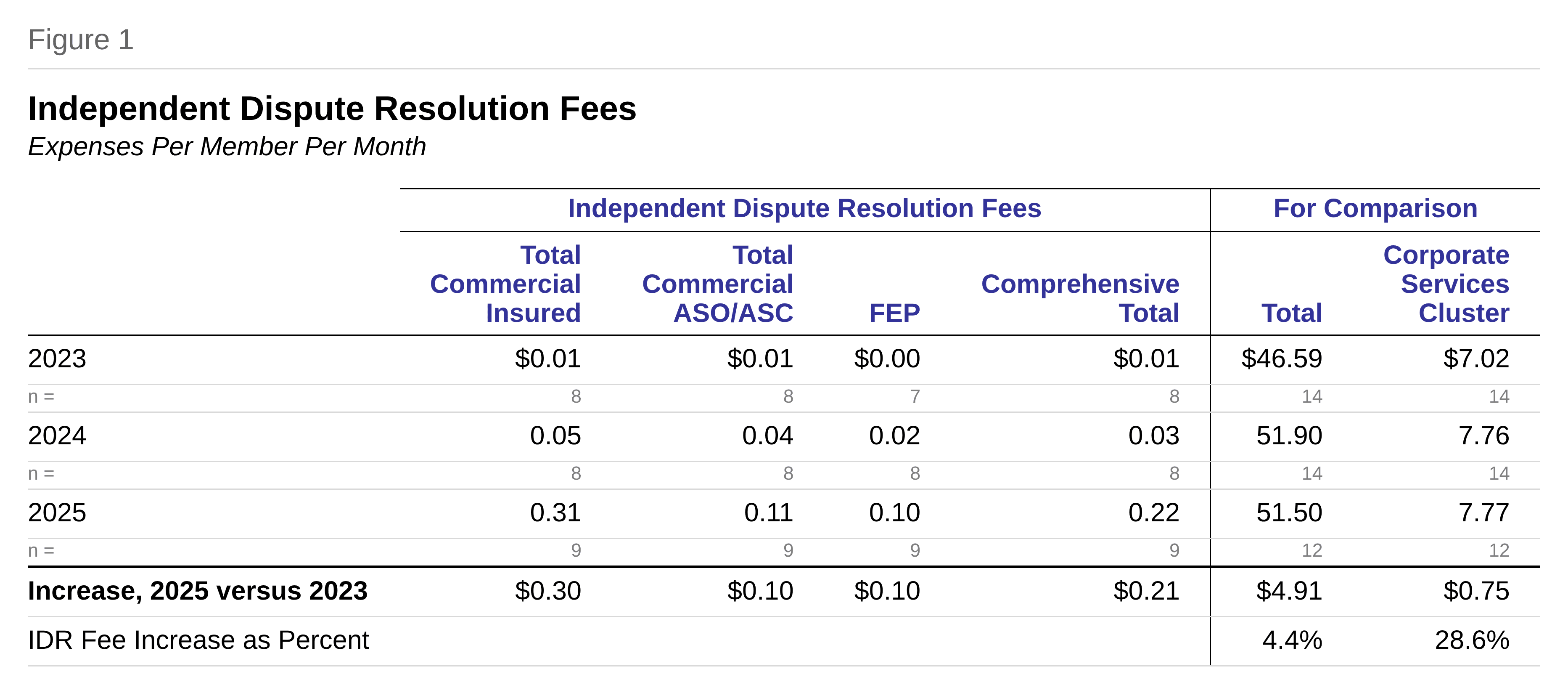
Nevertheless, a look at the Sherlock Benchmarks reveals an expansion in arbitration expenses that parallel health benefits. Figure 1 shows the PMPM costs by product from 2023, the first year our panel of Blue Cross Blue Shield Plans decided to segment this cost for the Benchmarks. In 2025, the PMPM costs for this activity was $0.31 for Commercial Insured compared with $0.01 in 2023. A similar though less dramatic increase is evident in Commercial ASO/ASC, FEP and Comprehensive Total.
To put this in perspective, among the Plans polled in each year, Comprehensive expenses were higher by $4.91 per member per month between 2023 and 2025: the $0.21 higher values were 4.4% of that higher value. Within the Corporate Services Cluster during that period, the $0.21 higher cost in 2025 versus 2023 was 28.6% of its $0.75 higher per member costs.
Also, we roughly estimate that 0.7% of the members of Blue plans who submitted cost information would have a claim before such arbitration in which the plan must pay. This estimate is based in part on information from the publication “The Substantial Costs Of The No Surprises Act Arbitration Process” by Jack Hoadley and Kennah Watts. In 2024, the median number E/R acute encounters per commercial member was 0.223, according to the 2025 Sherlock Benchmarks.
For better or worse, Brookings Institution observed that in two nationwide studies prior to 2017 found that 20 percent of emergency department visits and resulting admissions at in-network facilities involved an out-of-network physician.
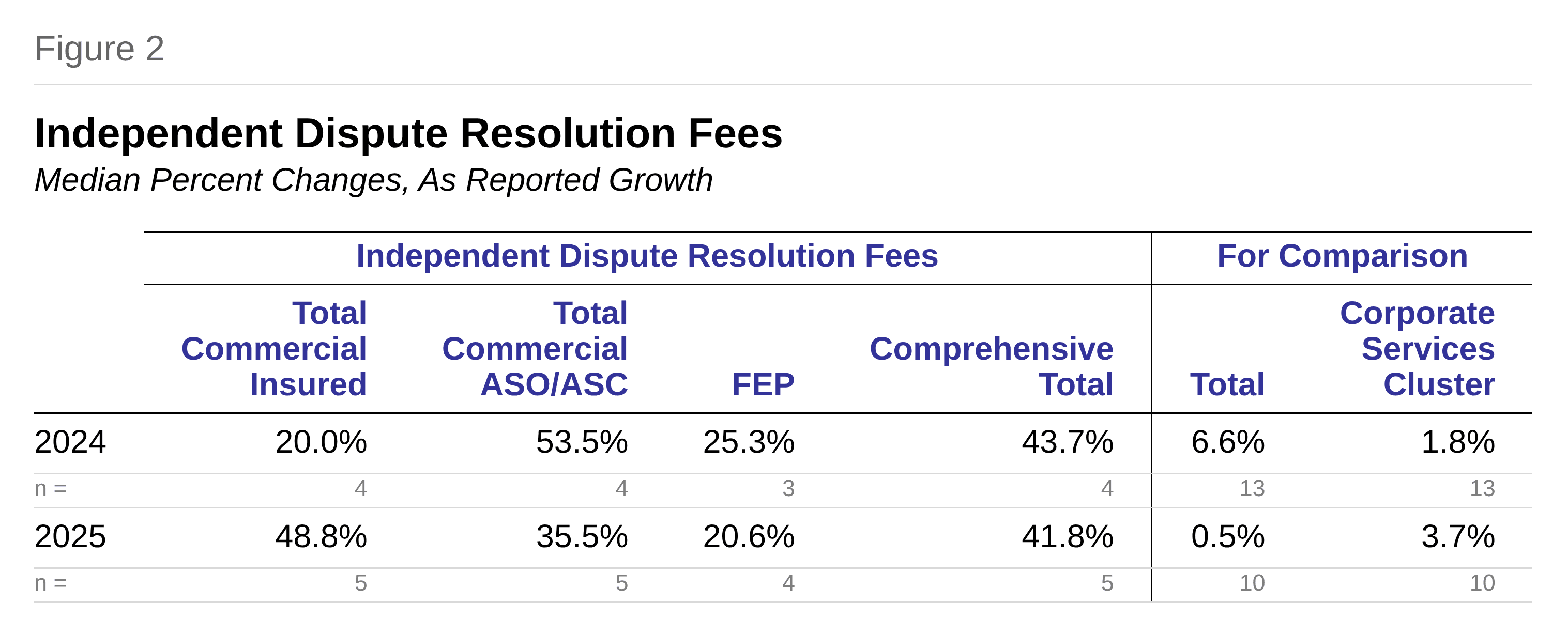
We also calculated the median changes for selected products for continuously participating Plans. Figure 2 differs from Figure 1 because the percents changes are of Plans participating in both years of each comparison. The trend participation numbers differ from total participation numbers because of turnovers in Plans, and changes in each Plans’ reporting. Comprehensive expense growth was extremely rapid in both 2024 and 2025, 43.7% and 41.8%, respectively. Growth in Independent Dispute Resolution Fees greatly exceeded the as-reported Total expense growth of 6.6% and 0.5% in those periods. Similarly, they exceeded the Corporate Services expense growth of 1.8% and 3.7%.
Please do not hesitate to reach out to us with any questions on this analysis. Doug Sherlock can be reached at sherlock@sherlockco.com.
Appendix
Functions Included in Administrative Expense Clusters
Sales & Marketing
1. Rating and Underwriting
(a) Employer Group Reporting
(b) Risk Adjustment
(c) Other Rating and Underwriting
2. Marketing
(a) Product Development and Market Research
(b) Member and Group Communication
(c) Other Marketing
3. Sales
(a) Account Services
(b) Internal Sales Commissions
(c) Other Sales
4. External Broker Commissions
5. Advertising and Promotion
(a) Media and Advertising
(b) Charitable Contributions
Provider & Medical Management
6. Provider Network Management and Services
(a) Provider Relations Services
(b) Provider Contracting
(1) Provider Configuration
(2) Other Provider Contracting
(c) Other Provider Network Management and Services
7. Medical Management / Quality Assurance / Wellness
(a) Precertification
(b) Case Management
(c) Disease Management
(d) Nurse Information Line
(e) Health and Wellness
(f) Quality Components
(g) Medical Informatics
(h) Utilization Review
(i) Other Medical Management
Account & Membership Administration
8. Enrollment / Membership / Billing
9. Customer Services
(a) Member Services
(c) Grievances and Appeals
10. Claim and Encounter Capture and Adjudication
(a) Coordination of Benefits (COB) and Subrogation
(b) BlueCard Home and Custom Par Fees
(c) Medicare Crossover Fees
(d) Payment Integrity
(e) Other Claim and Encounter Capture and Adjudication
11. Information Systems Expenses
(a) Operations and Support Services
(b) Applications Maintenance
(1) Benefit Configuration
(2) Other Applications Maintenance
(c) Applications Acquisition and Development
(1) Applications Amortization and Licensing Expenses
(2) Pre-Planning Project Costs
(d) Security Administration and Enforcement
Corporate Services
12. Finance and Accounting
(a) Credit Card Fees
(b) Other Finance and Accounting
13. Actuarial
14. Corporate Services Function
(a) Human Resources
(b) Legal
(1) Compliance
(2) Government Affairs
(3) Outside Litigation
(4) Fraud, Waste & Abuse
(5) Independent Dispute Resolution Fees
(6) All Other Legal
(c) Facilities
(d) OPEB
(e) Audit
(f) Purchasing
(g) Imaging
(h) Printing and Mailroom
(i) Risk Management
(j) Other Corporate Services Function
15. Corporate Executive & Governance
(a) Strategic Expenses
(b) Management Consulting
(c) Other Corporate Executive and Governance
16. Association Dues and License / Filing Fees
Note on the Sherlock Benchmarks
This analysis is based on excerpts from the Blue Cross Blue Shield edition of the 2026 Sherlock Benchmarks.
The Sherlock Benchmarks are the health plan industry’s metrics informing the management of administrative activities. They are based on validated surveys of approximately 30 health plans serving over 52 million Americans and provide costs and their drivers on key administrative activities. The Benchmarks are reported in multiple universes of health plans: Larger Plans, Blue Cross Blue Shield, Independent / Provider-Sponsored, Medicare and Medicaid.
The Sherlock Benchmarks are the “gold standard” of health plan administrative cost benchmarks. Health plans use them to determine whether their administrative costs are competitive, to prioritize for improvement among numerous specific activities and to identify cost drivers such as staffing ratios that, overall and within functions, can help implement those improvements.
Tables of Contents, report formats, citations, quality assurance and other information can be found on our Benchmarks overview.
In addition, the Sherlock Company website has an application that allows you to try out the Benchmarks free of charge.
If you are interested in considering licensing the Sherlock Benchmarks, we hope you will not hesitate to contact us at sherlock@sherlockco.com. You will be in good company.